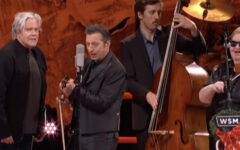

Mayne Smith at the Bluegrass Music Symposium – photo © Carl Fleischhauer;
and with the Pigeon Hill Boys – photo © Ann Milovsoroff
This remembrance of Mayne Smith (March 15, 1939-November 12, 2025) is a contribution from Neil V. Rosenberg, noted bluegrass writer and academic, and 2014 inductee into the Bluegrass Music Hall of Fame.
Loyd Mayne Smith, pioneer bluegrass music scholar and outstanding musician, died in Richmond, California on November 12, 2025. Born in 1939 in Cambridge, MA, his family had many folk music records and saw to it that he had voice and guitar lessons – the beginnings of a life-long career in music. He moved to Berkeley, CA in 1953 when his father, Henry Nash Smith, a prominent expert on the literature of the West, joined the faculty at the University of California.
I met Mayne when he arrived in Berkeley — we were the same age — and he encouraged me to take up the guitar. From then up through 1964 we often performed together, including at The Midnight Special, a live weekly show at KPFA-FM in Berkeley. In 1957 we both went to Oberlin College, where we discovered bluegrass.
In the summer of 1959 he joined Scott Hambly, Pete Berg, and me to create The Redwood Canyon Ramblers, which the California Bluegrass Association honored in 2019 as “The First Bluegrass Band In Northern California”. It performed around the Bay Area with various members until 1963, and later, in 1991, did a reunion tour of Japan.
In 1962 Mayne enrolled in Indiana University’s Folklore Institute, and at it in August 1964, completed his M.A. thesis, Bluegrass Music and Musicians: An Introductory Study of a Musical Style in its Cultural Context. The following year, having moved to Los Angeles to study at UCLA, he published a revision of his thesis, An Introduction to Bluegrass, in the Journal of American Folklore. In 2004 it was reprinted by Thomas Goldsmith in The Bluegrass Reader (Urbana: U of IL Pr.. pp. 77-91).
In 1965 he left academia and became immersed in LA’s folk music scene. He later described his experiences there: “over the next four years I hung out at the Ash Grove and McCabe’s Guitar Shop and picked with people like Ry Cooder, Taj Mahal, John Fahey, Bobby Kimmel, Mark LeVine, David Lindley, Richard Greene, and Peter Feldmann. The commercial music world was opening up to roots-based innovations.”
During this time, he developed an interest in songwriting and soon was performing solo as a singer-songwriter. Among the performers who would record his compositions were Linda Ronstadt and Rosalie Sorrels. By this time, he’d taken up the Dobro, and within a few years was playing the pedal steel guitar, and learned that he preferred working in bands, rather than as a soloist.
His musical career continued in 1969 when he returned to the Bay Area. He later recalled playing in bands of many styles — bluegrass, country-rock, folk-rock, and commercial county. He was a key member of Frontier Constabulary, a popular country-rock combo that worked in northern California from 1969 to 1974, and at this time he began performing with Mitch Greenhill, a blues guitarist with whom he collaborated on an occasional basis for the next forty years and more, touring in Europe and making three albums.
From 1977 on he took on day jobs, first learning the instrument repair trade at Kamimoto String Instruments in Oakland, and then with Bill Russell Capos; later he became involved in computer-based publishing. He ended his day job career working for Swords to Plowshares, a non-profit organization in San Francisco that helps disadvantaged veterans.
Meanwhile, in the early ’80s he became the leader of Alternate Roots, a band that held weekly jam sessions at a then-new Berkeley folk music venue, The Freight & Salvage Coffeehouse. After the Freight became a non-profit, he became its first board chair, helping to guide this now world-famous site for traditional music as it grew into a community arts organization, located in the heart of the Berkeley Arts District.
In June 2008, he released Places I’ve Been: A Songwriter’s Retrospective, an album of his songs which included four newly recorded tracks by the original Redwood Canyon Ramblers.
He is survived by wife Gail Wilson-Smith, sisters Janet and Harriet, and son Noah Smith.
R.I.P., Mayne Smith.