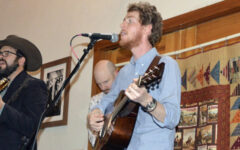

Long Way Home with Tijmen Veelenturf at Bluegrass in La Roche 2025 – photo © Angelika Hernmarck
This report on day three at France’s Bluegrass in La Roche festival is a contribution from Swiss bluegrass writer and promoter Angelika Hernmarck. She will provide a daily update this week as the music rolls on.
Friday’s official program didn’t begin until 6:00 p.m., but between noon and 2:00, eight bands had already performed at cafés around town. A bustling flea market attracted rare-find hunters, and the legendary jam sessions in front of the town church took place under gorgeous sunshine.
Unfortunately, I missed all of that because I set out on a mission to explore the much-talked-about festival campground. Like everything else at this event, it was clearly signposted and easy to find. It’s a huge site, filled with row after row of neatly pitched tents and campers. There are designated noisy zones for jamming and quiet zones for sleeping. I stumbled across a small group of Kids on Bluegrass Europe participants rehearsing for their Saturday performance, and I also found the EBMA-hosted dobro workshop with Billy Cardine taking place here — a satellite event of the festival.
So if you’ve got camping gear and love late-night jams, this is the place to be. It’s one more level of community, good vibes, and kind people everywhere.
At 4:00 p.m., the Maison des Sociétés hosted another important event: the European Bluegrass Museum Meeting at La Roche. A small but committed group of people gathered to continue exchanging ideas about how to preserve the archives and histories of Europe’s bluegrass pioneers for future generations, while also educating new audiences. A committee chaired by Paolo Dettwiler is currently establishing a research network on the history of bluegrass in Europe. Historians, archivists, ethnomusicologists, and if you read this: anyone with interest are warmly invited to join.
After that, we settled in at the main festival grounds, keeping one eye on the sky. Rain and thunder on Friday nights have become something of a La Roche tradition — one year, it poured so hard they had to move the rest of the show into the gymnasium. But tonight? Maybe it would hold. Or maybe not?
As the first band, Long Way Home, launched into their set, the skies played their own tune — clouds, a light drizzle, then sun, then sun with rain — but eventually the storm wandered off to bother someone else. That gave Kylie Kay Anderson (mandolin), Owen Schinke (dobro), Katja Grabe (bass), Lukas Grabe (banjo), and Paul Ahrend (guitar) the chance to deliver their gorgeous set of traditional and original songs to a very appreciative early crowd. Long Way Home just became one of my new favorite bands.
They were followed by the ever-energizing G-Runs ‘n Roses, led by multi-instrumentalist Ralph Schut (on banjo with this band), with Milan Marek (mandolin), Vladimir Križan (guitar), Christopher Schut (bass), and Peter Burza (fiddle). I’ve loved this band since Ralph founded it in 2006. The current lineup, which came together in 2022, is somehow even more energetic than before. The brother harmonies are an added asset! Their stage presence is top-notch — it’s pure joy to watch them.
Next up was Italy’s Red Wine, formed back in 1978(!). Founding members Silvio Ferretti (banjo) and Martino Coppo (mandolin and mandola) were joined by two younger musicians: Lucas Bellotti on bass and Marco Ferretti on guitar — who, by the way, is a superb banjo player himself, just like his father. For one tune, they brought on special guests Paul van Vlodrop and Teo and Miles Quale of The Crying Uncle Band. Together they performed David Grisman’s famous instrumental, Dawg’s Bull, with three mandolins. Pure brilliance! (Yes, it’s also one of my all-time favorite pieces.)
One of the evening’s top highlights, of course, was the amazing Della Mae. They brought tremendous energy, and the crowd was absolutely packed in, loving every moment.
But the final act of the night was still to come. Swedish band Le Chat Mort took the stage just as a rather heavy rain cell swept across the festival grounds — one of those classic La Roche moments that sent a good portion of the crowd running for shelter or home. But after about 15 minutes, the rain stopped, and the undaunted listeners who had stuck it out were rewarded with a cheerful and high-spirited set. Around lead singer and snare drummer Camilla Neideman, the trio of Bror David Neideman (banjo), Peter Strömquist (guitar), and Matti Friberg (bass) delivered catchy melodies, good vibes, and a joyful presence that turned a wet ending into a memorable one.
Now, you may be wondering why I’m not going into more musical detail today — it’s simply because I also want to share a few other things about the festival that make it so special.
Let’s start with the Luthiers & Accessories Hall — a paradise for any bluegrass musician. You’ll find custom guitars by Lucien Magana, beautifully crafted instruments, and Bulas Instruments from Poland with banjos and mandolins. Capek Instruments, represented by Rosta and Ivana Capek from the Czech Republic, brought their incredible line of banjos, mandolins, and accessories. Richard Cifersky from Slovakia was there with his Banjolit gear, and from Italy came Massimo Gatti with his handcrafted MG Mandolins. There were also vendors selling straps, picks made from natural materials, and all kinds of musician’s treasures. As soon as the hall opens, music rings out from every corner. People chat, try things out, compare notes, and maybe even haggle over a price or two.
A unique feature of this festival is the visible security presence. Since the Charlie Hebdo attacks, all backpacks are checked at the festival entrance. More charming, though, are the local police officers who patrol the grounds in pairs or trios — and for this event, they wear cowboy hats! They look great, and many visitors love posing for photos with them (I’ll skip the selfie this year…).
Like many festivals, La Roche has embraced a sustainability policy. The collectible drinking cups, printed with the year’s design, have become sought-after souvenirs. Who out there has the full set?
The festival currency, EuroCH, is another smart touch. They’ve evolved from paper bills to pocket-sized cards in 10 EUROCH denominations. You simply get your drinks or food marked off on the card. It’s neat, secure, and helps keep things safe for the hundreds of volunteers handling food and drinks across the site. And believe me, there are many of them out there serving in particular at the food and drink stations.
Which brings me to the food. The menu is limited but solid: jambalaya, chili sin carne, and a regional specialty called Croziflette — a delicious combo of pasta, Reblochon cheese, onions, and bacon. There are also salads, burgers, and saucisse in several sizes and flavors. But the runaway favorites? The frites, sold by the thousands, and the jambon — thick-cut roasted ham served on top of a mountain of fries. Yummy! (Don’t worry — I’ll spare you the close-up food photos. After all, this is just a delightful but minor part of the story.)
Thanks to one of the main sponsors, Brasserie du Mont Blanc, there’s also a wide selection of beer — served by cup or by the liter. There’s also wine (we’re in France, after all!), soft drinks, and yes, even coffee.
Right now, the second band of the day is playing on the small outdoor stage. Just before them, we heard the youngest performers: the Kids on Bluegrass Europe.
But that’s a story for tomorrow…
See you then, right back here!