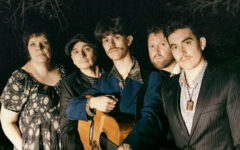
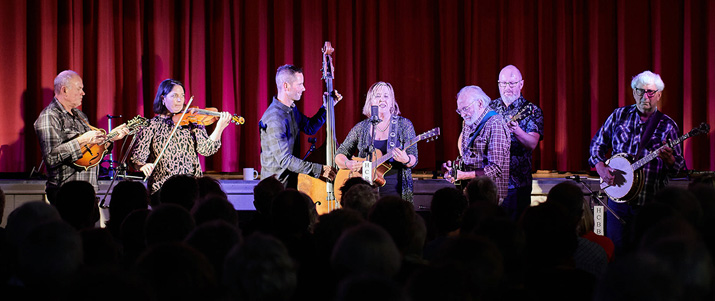
The Hamilton County Bluegrass Band ranks as one of the most storied bluegrass bands in the history of New Zealand’s music scene. Paul Trenwith and Alan Rhodes formed the group in 1966, but played their last official concert in March of 2025. At the time, Trenwith and Rhodes remained the only two original members. “We just decided it was time to put the band to rest,” Trenwith says in retrospect. “Alan isn’t doing any playing due to health problems. However I still play regularly with my sons and can fool most of the people with my (diminishing) banjo skills.”
The band originated in the Trenwith home located just north of Hamilton, New Zealand. That’s where high school friends Trenwith and Rhodes found a common connection through the folk music of the time, and from there, ventured into the realms of bluegrass music via the theme from The Beverly Hillbillies TV show. They made other musical connections in local folk clubs and those located in Auckland, approximately an hour and a half drive north from their hometown. Early on, they spent their time traveling back and forth in order to share their musical discoveries.
In addition to Rhodes on guitar and Trenwith on banjo, the original band included David Calder (mandolin), Colleen Bain (fiddle), Leonard Cohen (mouth harp, guitar and later dobro), and a Canadian student studying at Auckland University named Sandy “Bob” McMillin (double bass). This line-up remained intact until McMillin returned to Canada and was replaced by Lyndsay Bedogni on bass. Once Cohen left for Australia, the band continued as a five-piece.
Other personnel changes transpired later on. In late 1970, Bedogni left to pursue overseas travel ambitions. Calder departed as well, and the two were replaced by Miles Reay on bass, and Graham Lovejoy on mandolin. “This was the band that travelled to Australia to widen our audiences and seek our fortunes!” Trenwith says. “In early 1971, we also travelled to the USA. We then returned to Australia, and played our music there until the end of 1972, when we returned to New Zealand and effectively ended full-time music, though we continued playing whenever opportunity arose.”
Trenwith and Bain married in 1970, and moved to Australia in 1974 to work as full time musicians for the popular Slim Dusty Show, Australia’s so-called “King of Country Music.” They also played on his recordings and concerts until the end of 1976 before subsequently returning to New Zealand.
The pair continued to put bluegrass front and center throughout the ’70s and ’80s. They formed a bluegrass/gospel group with friends from their church, and performed at concerts, church services, and other events, playing original songs while spotlighting their instrumental expertise.
In the early 1990s, Hamilton County Bluegrass Band reunited. “We realized we enjoyed playing together as a band,” Trenwith remembers. “Alan, David, Colleen and I started playing when we had opportunities, along with my oldest son Jeremy Trenwith on bass. In 2005 we were offered an exciting tour of New Zealand and Jeremy was replaced by my son Tim. He has retained the bass spot since then.”
Around this time Colleen Trenwith moved to the US to study, and although she played with the band on return visits, a woman named Pam Crowe was recruited to join the group in her absence. “She was a vocalist and added a new dimension to our sound,” Trenwith explains. “In 2012, David left the group and we enlisted local Hamilton luthier Keith MacMillan on mandolin. Jeremy’s wife Victoria Trenwith also joined us on fiddle.”
Trenwith senior traced the band’s early influences to early records by Flatt & Scruggs (Live at Carnegie Hall, Live at Vanderbilt University), the Dillards (Live Almost, Back Porch Bluegrass), and Earl Taylor (Bluegrass Taylor-Made). Trenwith adds that the latter, “was the first time we heard fiddle and mandolin in the same band.” Other inspirations included Reno & Smiley, the New Lost City Ramblers, and the groups belonging to Mountain Music Bluegrass Style. “As my record collection grew, our influences broadened, and we fairly rapidly found our own version of bluegrass music. We loved the music of the Stanley Brothers, and Emerson & Waldron too. Our first single was Barefoot Nellie backed with Never Get To Hold You – both Reno & Smiley songs.”
The band’s early recordings included other covers of tunes from imported albums, but eventually they developed their own material as well. The album Yesterday‘s Gone, released in 1969, was the first to feature original songs, and all their subsequent albums have had a mix of both. “We tend to come up with our own versions of songs we’re covering,” Trenwith says. “An example is Take It Easy. We doubled the rhythm so it became a very fast bluegrass song, but the vocals were about the same speed as the original.” Another popular song in their early years was James Taylor’s Carolina In My Mind.
“Because we seldom played to a ‘bluegrass’ audience’ — one where most were familiar with the genre — we soon found that selecting a repertoire that would be familiar to the audience helped in their appreciation of our music,” Trenwirth adds. “We always knew it was our job to entertain them, and that educating them was further down the list. Later in our career, we just picked songs we liked and did them our style. Country songs, folky songs, self-penned songs, pop songs.”
They also had several lucky breaks along the way.
“The Hamilton County Bluegrass Band’s early popularity, apart from our folk-club audiences in New Zealand, was due to our role as the backing band in a nationally-transmitted prime time TV show called Country Touch, which aired on the only New Zealand TV channel in 1967,” Trenwith explains. “The show was extremely well put together, featuring local singers, a dynamic square dance group, and Tex Morton, a legendary country music performer from the earliest days of NZ country music, as host, as well as the youthful, energetic faces and musical skills of the HCBB. We became very popular throughout New Zealand, and subsequently played concerts — our own, and in conjunction with others — throughout the country. I think we’ve played every city, most large towns, and lots of events there. We toured as part of concert tours with folk singer Julie Felix and Slim Dusty, as well as with many prominent New Zealand performers. They would run for sixteen weeks, six nights a week!”
In fact, the touring continued practically nonstop.
“When we moved to Australia in 1971 – with Tex Morton’s encouragement – we met up again with Slim Dusty, and toured with his show, throughout New South Wales, Queensland, Northern Territory, and Victoria,” Trenwith relates. “It was the longest tour we undertook, lasting three and a half months and six nights a week.”
The band was also responsible for organizing some seminal events at home. In 1967, they helped organize the National Banjo Pickers’ Convention, a gathering of players from around the country. A second gathering a year later drew a much larger crowd. In 1969, Mike Seeger made a guest appearance, giving the gathering a major boost. In 1970, Bill Clifton made a guest appearance, and that led to the group recording an album with him, Two Shades of Bluegrass.
When Hamilton County Bluegrass Band went to the US in 1971, Mike Seeger arranged for them to play at the Grand Ole Opry. They also spent a week at Bill Monroe’s Bean Blossom Festival, and became fully immersed in the local bluegrass scene. “We played to a very receptive audience who loved our take on bluegrass, and especially Colleen, who was one of only two women on the Saturday afternoon show,” Trenwith recalls. “We also visited Carlton Haney’s Berryville, again to enthusiastic audiences.”
Afterwards, Mike Seeger hosted them at his home where they were able to jam with other local musicians.
In 2008, the HCBB were invited to be one of the international bands at the River Of Music Party – ROMP Festival. “On the way over, we stopped in San Francisco and played as guests at the Grass Valley Father’s Day Festival,” Trenwith says. “We had a great reception at ROMP, receiving a standing ovation at the completion of our set. It was a real thrill for us!”
In addition, the group participated in two Bluegrass Cruises around New Zealand and Australia, and also travelled far into Australia’s outback to play at a festival in an opal-mining town. They appeared at various festivals in Australia, including Mountaingrass and Redlands, and participated in New Zealand’s Kiwigrass festivals in 2019, 2020, and 2021.
Their efforts have paid off. “Audiences have always appreciated our enthusiasm, our dexterity, and obvious competence on the instruments, and we have always endeavored to put together a show that will entertain and delight,” Trenwith insists. “The songs are drawn from many sources, and we like to think that there is something special in each show for every single audience member. That said, I think a real bluegrass enthusiast wouldn’t be disillusioned by our choices. Someone who knew nothing of bluegrass music would enjoy what we’ve played for them too.”
He says they’ve been fortunate to have great singers in the band, with pleasant voices and the ability to harmonize well. “That plus exciting instrumental work usually keeps our audiences happy, and often wanting more.”
The band left behind a notable recording legacy as well. “The HCBB were fortunate in our very early days to be friends with John Ruffell and Robin Gummer, two men who were keen to record our music,” Trenwith recalls. “Both were immensely talented, building some of their equipment themselves, and gave us frequent opportunities to record our music to a very high standard of sound. It was usually released on the Kiwi-Pacific label. In the early years of 1966-1970, we recorded probably a dozen albums, some just HCBB, and others as part of concerts or events such as the National Banjo Pickers Conventions. Until 1973, we made at least one album a year, then after that, several albums until our final one in 2016.”
These days, Trenwith looks back on the band’s legacy with both pride and satisfaction.
“In March 2024, Alan and I decided that it was time to call it quits for the HCBB,” Trenwith explains. “Alan was having trouble with arthritic fingers, making guitar playing difficult. His voice still sounded great, but it wasn’t quite the same without being able to drive the rhythm along as he used to. My fingers were working okay, a little slower, but I could compensate for that by playing carefully. My failing hearing made being part of a noisy environment difficult. Hearing aids helped, but also exacerbated the problem. The others in the band had busy lives, and we needed to get together more often if we were to continue to present the HCBB in the manner begun almost sixty years previously. Our last gig was a two-hour concert in nearby Cambridge, and we played to a very receptive crowd, many of whom realized it was our last gig. There was no big finale, just the usual ‘thanks and goodbye.’ We New Zealanders tend to understate things.”
Indeed, there are no regrets.
“The Hamilton County Bluegrass Band had a fine career, made many friends, and played some fine music. We’re happy with that legacy.”