
It happens every four years now: we all see a lot of curling on television and people tend to be baffled by it. Some enjoy it anyway, some don’t, and some make tired jokes about it (see final paragraph). Well, strange as it sounds, I actually play this sport in northern Alberta (though not this season because I’ve been recuperating from three broken ribs and doing my best to avoid falling on ice).
This column first appeared in 2018 during that year’s Winter Olympics , but I’ve made some important updates because sweeping strategy has changed quite a bit in the last eight years.
First, a disclaimer: this column will be longer than most, but you can console yourself with the knowledge that you will probably just skim the last half of it anyway, at most. There will at least be pictures.
“What the *%##**% does this have to do with bluegrass??!” I hear you asking, and it’s a valid question. My answer: nothing. However, as I thought more about it, bluegrass and curling do have some fundamental things in common:
Both were started by someone of Scottish descent. Bill Monroe was proud of his Scottish heritage, and even named a tune for it; curling was started in Scotland in the 16th century on frozen ponds, when farmers, realizing it was too cold to golf (that other peculiar but strangely addictive Scottish game), started shoving rocks down the ice for lack of a better plan.
As in bluegrass, there’s very little money in curling: when the biggest curling stars in Canada are introduced on television, their day jobs are often flashed up on the screen.
On a related note, it’s also very affordable to play it, though the equipment can sometimes be costly (okay, bluegrass equipment is costlier).
Both bluegrass and curling require lots of precision and skill, but people of any skill level can still play it, and the skilled and unskilled can often be found playing with each other recreationally.
Curlers who go on the road as a team tend to play in smaller cities and stay in, well, crappy hotel rooms.
Also, the Norwegian team seems to be wearing Bill Knowlton’s pants.
So there you go. We might as well be talking about bluegrass. Just a note about the discussion below: it mostly covers conventional team curling as opposed to the new mixed doubles format you may have seen in the past week (even I have trouble explaining that). Also, please bear with me; I’ve likened explaining curling to the uninitiated to explaining baseball to Europeans (“no, in this case the batter is out because he fouled the ball while bunting . . . with two strikes . . . never mind”).
I thought I’d tackle this using curling FAQ:
What do the rings mean, and do different-colored rings mean different numbers of points?
The rings are really for reference only and to make it easier to see which rocks are closer to the center, which is the only thing that matters in terms of scoring. The score in a given “end” of curling is determined entirely by which team has more rocks (or “stones”—either name works) closer to the center than their opponents do, and how many. The round “bullseye” at the center of the rings is called “the button,” but again it doesn’t score more or less to be there. Only one team can score in an end, so if team A has two closest to the center of “the house” (all the rings) after the last stone is thrown, they score two and team B scores zero. In this photo, red would be scoring one because they’re closest, but only one because the yellow rock outcounts the other red one at the edge of the rings.
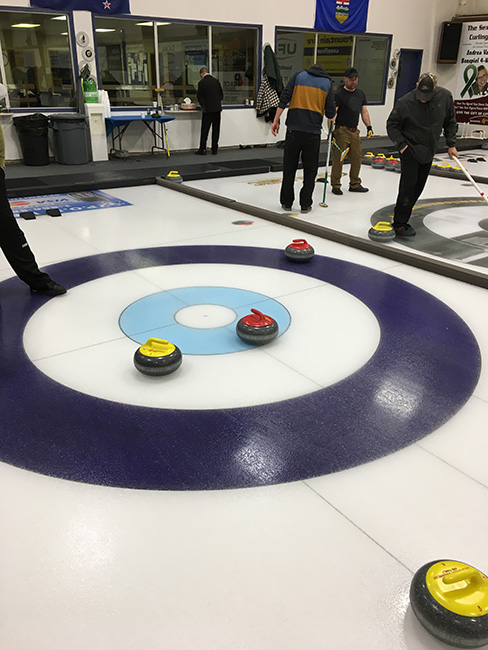
If a rock is just barely touching the edge of the button, it’s called “biting the button,” which is fun to say.
I keep hearing the announcers referring to “the hammer.” What is that? I don’t see a hammer anywhere.
“The hammer” merely refers to the last rock thrown in the end. If a team “has the hammer,” it means they have last rock advantage. This is a tremendous edge in curling, because if you can get just your last rock in closer than all your opponents’, it doesn’t matter how many they have; you’ll still score one. Important strategic note: once a team scores in the end, they give up the hammer to the opposing team. That’s why at the higher levels of play, it’s really the goal of the team with the hammer to score two, since giving up the hammer for a single point isn’t considered worth it. That’s why you’ll sometimes see the team with the hammer attempt to spill all stones out of the house on their last rock to deliberately score zero, thereby retaining the hammer for the next end when they hope to get better set up to score two.
Why is it called “curling” in the first place?
It’s because of the curling action of the stones. When one of the players throws their stone, they will turn the handle in one direction or the other, and it will then “curl” varying amounts as it travels down the sheet of ice.
I see some players throwing their rocks and having them not even make it into the house. Then the crowd cheers. What’s good about that?
That’s because they’ve just successfully put up a “guard,” meant to either protect another stone in the house, or perhaps block a future shot by the other team, or maybe guard your own stone that you’ll try to get to curl around the guard. The crowd cheers because that was the shot that was called for by the “skip” at the other end. If the skip had called for the rock to be in the house, or to take another rock out, that shot wouldn’t be so good then (the crowd would be politely silent or possibly let out an audible sigh). Guard placement is very important and requires precision because good curlers have ways of getting around them if necessary.
Who sweeps on the team?
Everybody is doing something all the time, so everybody sweeps when they’re not throwing their rocks (each player on a four-person team throws two each). The exception to this is the skip, who is down at the other end handling all the strategic decisions and holding the broom for the other player to aim at, though the skip will often sweep within the house at that end, if needed.
What does sweeping do?
It used to do two things, but with the advent of legal “directional sweeping,” it now does three possible things: it helps create a warmed path for the rock, which causes it to go farther. It also can hold “the line” of the rock, delaying how soon it curls and how much, keeping the rock straighter. The two goals can sometimes be in conflict, and then it can get interesting, with conflicting instructions being shouted on the ice. The third thing is that sweepers who really know what they’re doing can sweep it in such a way to get it to curl more. This has become a very important part of the game. When trying to hold the line, or get it to do the opposite and curl more, you will only see one player sweeping at a time. That’s because the second sweeper, sweeping on the other side of the rock, would be likely to counteract what the first sweeper is doing. When they’re trying to get the stone to go farther, the more sweepers the better.
What’s all the shouting about?
All the shouting you hear is related to the sweeping, and it’s usually the skip doing the shouting, though sometimes the one who threw the rock will be chiming in on the other end. The skip is watching the line of the rock very carefully and may want to delay the curl—to get by a guard for example—so he/she will yell something like “HARD!!!!!!” (usually with that many exclamation points) to get the sweepers to do their best. The sweepers, meanwhile, are in charge of judging the “weight” of the throw and sweeping accordingly. If the rock was already thrown a little too hard, and may go farther than it was supposed to (“too much weight”) they’re not going to sweep it, but if the skip calls them on for the line, they’ll do it. Communication is key, though, so it’s up to the sweepers to shout to the skip that the rock is heavy, just so he/she knows. At other times, the shot may be light, so the sweepers are working away as hard as possible, but the skip wants it to curl more—to get behind a guard for example—so he/she may say “whoa!” or “whoa if you can!,” or “weight only!”, meaning sweep if you must for weight, but we need it to curl more. Skips, like lead singers, often get hoarse by the end of an event. For many skips, a typical game is the curling equivalent of singing The Mule Skinner Blues for two straight hours.
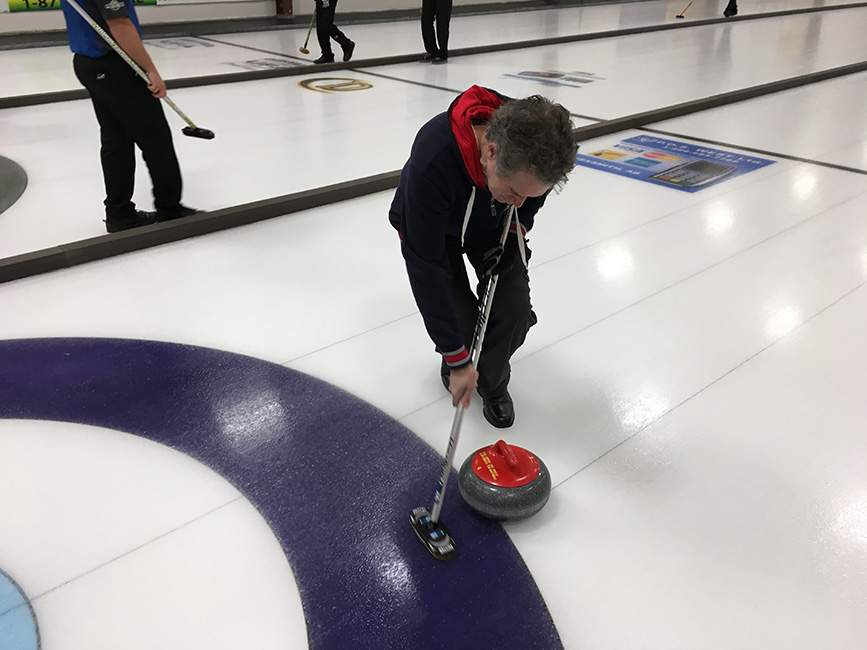
A familiar-looking sweeper, working really hard to get this rock into the house. The skip is probably shouting “HARD!!!!” and wondering where the other sweeper went:
At the beginning of an end, do skips tend to call the same kinds of shots?
Well, this brings up an US Olympic coverage pet peeve of mine: they often don’t show us the opening shots, so what we see is a house with rocks in it already, and we have no idea how they got there or why they’re there. This is like showing the second half of all nine innings of a baseball game. We’re left wondering how those runners got on base and how the two outs happened. But yes, just as in chess, there tend to be some standard openings before the end develops in its own way. For example the team without the hammer (who throws first) will often put up a center guard as a way of denying access to the center and making a final shot more difficult.
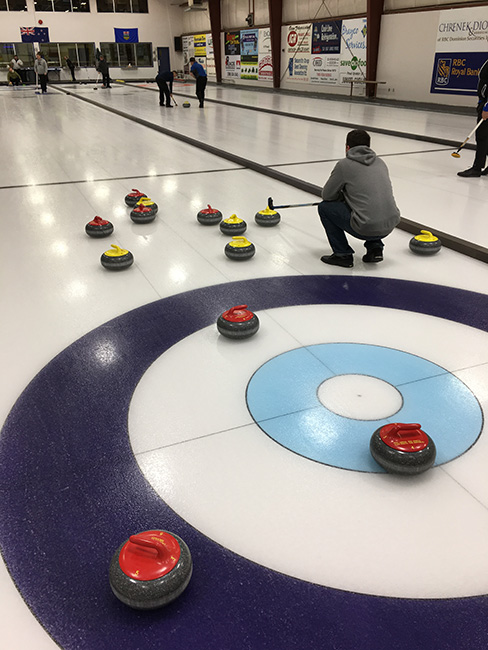
If you have the hammer and you’re yellow, this is what you don’t want: the front is all “junked up” and this skip now has to try to raise that yellow rock on the right side of the picture back at an angle to the button to try to score one.
If good curlers can get their rock to curl behind a guard to hide it, why can’t the other team just do the same thing and hit it out?
Because in order to hit and remove a stone you have to throw more weight, and the more weight that is thrown, the less the rock will curl, making it very difficult to get around the guard and get at the stone to hit. At the competitive and Olympic level, though, if even a little of the rock is visible behind the guard, it’s possible to remove it with a very precise “take out.” Another option is the “runback” in which one stone is hit on to another to remove it. Sometimes these shots get very complex:
What are the stones made of, and how heavy are they?
They’re made out of granite that all comes from the same area of Scotland. In UK terms, they weigh 3 stone, or 42 pounds. They’re not light.
What about the shoes? Are they special?
Yes, shoes made for curling will have a slider attached to the left shoe (for a righthander), and the right foot will have a grippy sole. This takes some getting used to if you haven’t used them before. It’s also possible to obtain a slip-on slider to put on ordinary tennis shoes (indoor shoes, though, because keeping debris off the ice is critical to not diverting the path of the stone).
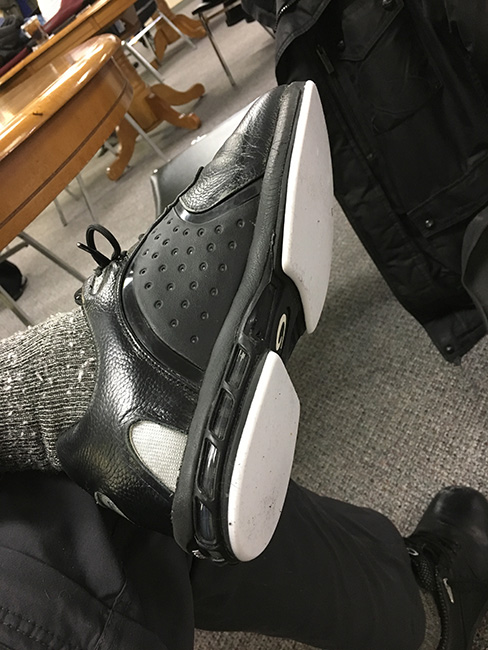
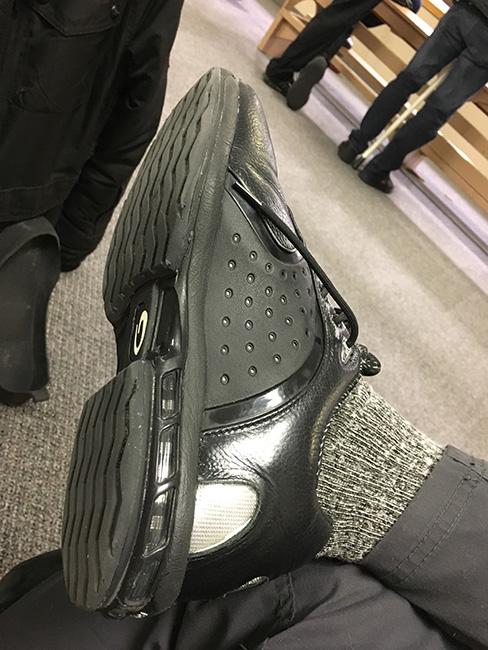
What’s the hardest part about delivering the rock the way they do on television?
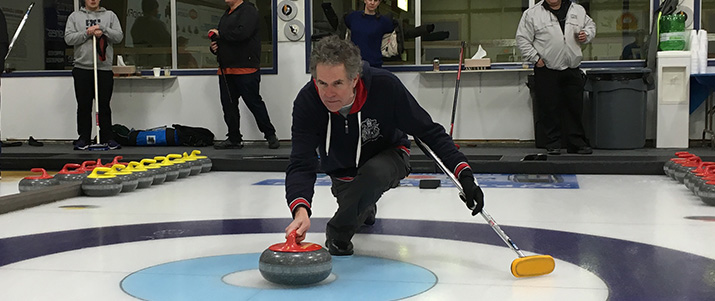
At first the biggest challenge is balance. Almost everyone falls down on their initial try. After you achieve some balance and flexibility, the challenge is controlling the weight of your throw to make the shot that’s called for, and “hitting the broom,” i.e. sliding as straight as you can toward the broom that the skip is holding for you at the other end. In this photo, I have no idea if I’m doing either:
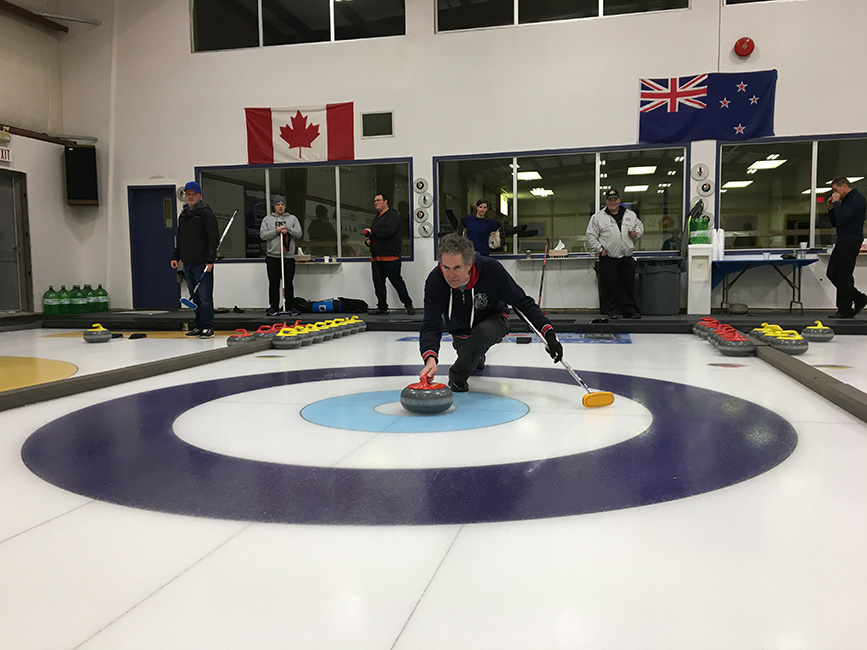
At this point, I’ll consider this TMCI (Too Much Curling Information), but I’ll just close by pointing out that making “sweeping” jokes about curling is the equivalent of slapping your knee and saying “yee haw” about bluegrass music, or saying “eh?” to Canadians. Consider it a social etiquette tip.
Enjoy the Olympics!
All photos were from Sexsmith Curling Club in Sexsmith, Alberta, all taken eight years ago during the Winter Olympics of 2018.